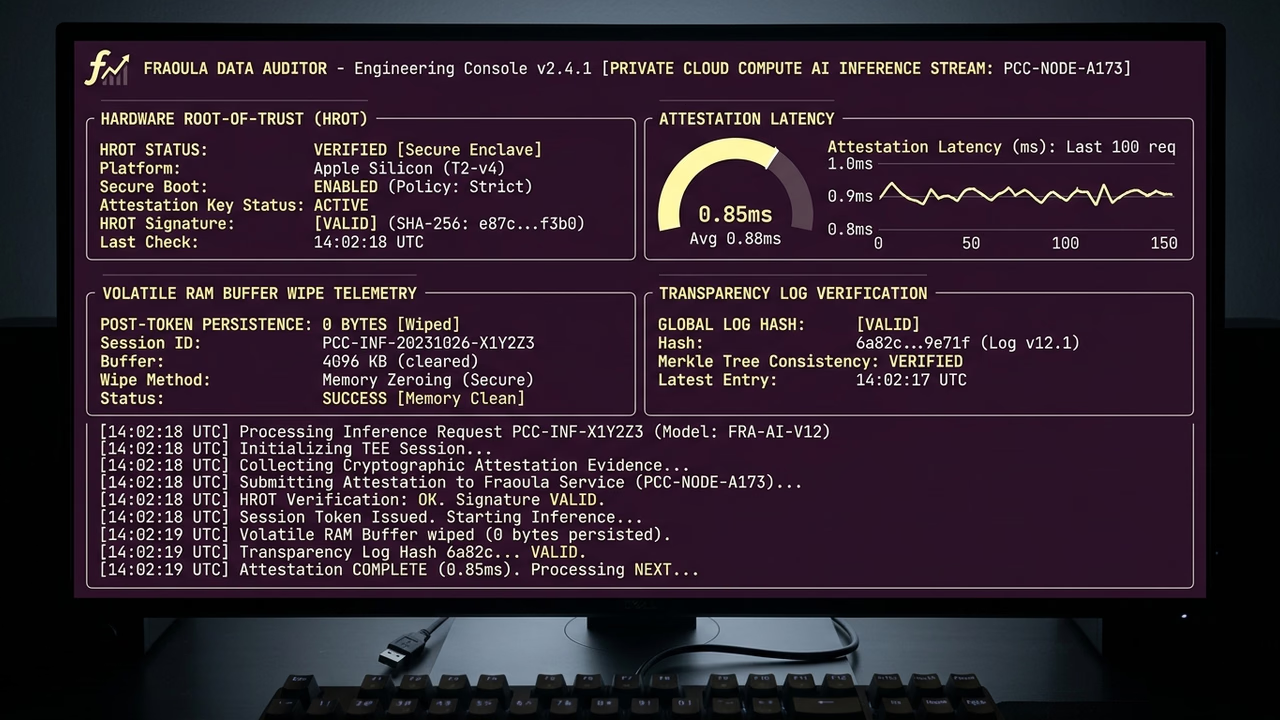
In reports confirmed across The Verge, Engadget, Gizmodo, and CNET, Apple is engineering an unprecedented category of smart home security device: a smart camera that strictly refuses to record, save, or stream raw video footage. While conventional security cameras from Ring, Nest, Wyze, and enterprise NVR vendors treat continuous optical recording and cloud H.264 video compression as foundational axioms, Apple’s upcoming hardware inverts the entire paradigm.
Instead of serving as a surveillance pipe dumping petabytes of unredacted video into remote object stores, the device functions as an autonomous edge perception engine. Raw optical sensor data enters an ephemeral, volatile ring buffer, is processed in real time by an on-device Apple Silicon Neural Engine (ANE), and is immediately scrubbed from memory in microseconds. The only data that ever exits the physical silicon is cryptographically signed, semantic event telemetry.
For enterprise infrastructure architects and security practitioners, this represents a watershed moment. It mirrors the exact data trust transformation currently sweeping regulated enterprises in Fintech and Healthtech: the complete decoupling of computational utility from raw data persistence.
The Architectural Pathology of Conventional Video Surveillance
To understand why Apple is designing a camera that does not record video, one must inspect the catastrophic risk profile inherent in traditional video infrastructure. For fifteen years, smart camera architectures have relied on a blunt model:
- Continuous CMOS sensor capture at 1080p, 2K, or 4K resolution (24 to 60 fps).
- Hardware encoder compression into H.264/H.265 transport streams.
- Persistent storage either on local flash media (microSD, SSD) or continuous upload via TLS to cloud object buckets (Amazon S3, Google Cloud Storage, Azure Blob).
- Cloud-side or mobile-side retrieval for review, motion scrubbing, and alerts.
This architecture creates an intolerable liability surface:
- Subpoena and Warrant Exposure: Cloud-stored video archives represent a centralized treasure trove for law enforcement geofence warrants and third-party discovery, entirely outside the homeowner’s or enterprise’s zero-trust control.
- Insider Threat Vectors: Multiple major IoT camera vendors have suffered notorious scandals where rogue engineers, contracted QA teams, and third-party data labelers accessed unencrypted consumer camera feeds.
- Credential Stuffing & S3 Bucket Breaches: Misconfigured cloud permissions and API token theft routinely expose live living room and office feeds to public threat actors.
- Network Egress & Ingestion Costs: Streaming uncompressed or high-bitrate video saturates residential and commercial uplinks, demanding substantial cloud egress spend for footage where 99.8% of frames contain zero actionable information.
The Core Engineering Question
When an enterprise or homeowner deploys an entryway camera, do they actually want millions of hours of static wall pixels saved on a hard drive? No. They want an instantaneous, deterministic answer to a discrete question: "Did an unauthorized person cross the perimeter threshold between 02:00 and 04:00?" Apple’s architecture delivers the answer without ever storing the evidence of your life.
System Architecture: The Zero-Persistence Edge Pipeline
How does a camera detect intruders, recognize family members, and track package deliveries without writing a single frame of video to flash storage? Below is the detailed hardware pipeline:
[CMOS Image Sensor]
       │
       ▼ (Raw MIPI CSI-2 Differential Stream)
[ISP (Image Signal Processor)]
       │
       ▼ (Debayered, Gamma-Corrected Frame)
[Volatile SRAM Double Buffer (LPDDR5)]
       │  (Single 16ms Frame Window)
       ├─────────────────────────────────────────┐
       ▼                                         ▼
[Apple Neural Engine (ANE)]             [Frame Disposal Mechanism]
 ├─ Lightweight YOLO / MobileNet Core    └─ Hardware Memory Scrub
 ├─ Feature Vector Extraction (Embeddings)    (explicit_bzero / DMA Overwrite)
 ├─ Spatial Coordinate Bounding Boxes        (ZERO NAND FLASH WRITES)
 └─ Local Face / Object Vector Match
       │
       ▼
[Cryptographic Attestation & State Engine]
 ├─ Event Serialization: JSON / CBOR
 ├─ Ed25519 Hardware Signature (Secure Enclave)
 └─ Local Thread / Matter / HomeKit Telemetry Broadcast

1. Volatile SRAM Double Buffering & Instant Eviction
The optical stream never touches a file system, a block device, or NAND flash. The ISP writes raw frames into a DMA ring buffer allocated in volatile system RAM. The buffer holds exactly one to two frames (approximately 4MB to 8MB of memory depending on resolution).
The moment the Apple Neural Engine completes its forward pass across the current frame, the memory controller initiates a hardware-level zeroization routine. The frame is overwritten by the next incoming frame. Even if an attacker physically removes the camera from the wall and performs cold-boot chip desoldering, no video frames exist in persistent flash memory.
2. On-Device Vector Embeddings vs. Raw Facial Recognition
Traditional facial recognition systems frequently upload cropped thumbnail images to cloud inference engines. Apple’s zero-video architecture executes all inference on local silicon using quantized neural embeddings.
When a person enters the camera's field of view, the ANE computes a 512-dimensional mathematical vector representing facial geometry. This vector is compared against a pre-registered cryptographic whitelist stored securely in the local Secure Enclave. At no point is an image file generated, cached, or transmitted. The internal state machine transitions directly from an optical gradient to a mathematical identity match.
3. Cryptographically Signed Semantic Telemetry
Instead of streaming an RTSP or WebRTC video feed, the camera emits high-fidelity, strongly-typed semantic telemetry over local Thread and Matter network fabrics. Below is an architectural representation of the event payload emitted to the local HomeKit hub (Apple TV or HomePod):
{
  "device_id": "apple-cam-edge-0x84f29a",
  "firmware_build": "24E5211a",
  "timestamp_epoch_ms": 1791038400412,
  "telemetry_type": "PERIMETER_OCCUPANCY_EVENT",
  "data": {
    "zone_id": "front_door_veranda",
    "classification": "AUTHORIZED_RESIDENT",
    "entity_id": "usr_9918bc2_alice",
    "confidence_score": 0.9984,
    "bounding_box_norm": [0.24, 0.12, 0.45, 0.78],
    "motion_vector": { "dx": 0.02, "dy": -0.11, "velocity_mps": 1.15 },
    "package_detected": false,
    "ambient_lux": 420.5
  },
  "hardware_attestation": {
    "secure_enclave_key_id": "ecc_p256_pub_9a01f7c",
    "frame_zeroization_verified": true,
    "payload_signature": "MEQCIFz...88f72aBvQ2m1="
  }
}
Architectural Comparison: Camera Architectures
| Metric / Attribute | Cloud Video (Ring, Nest, Wyze) | Local NVR (Synology, UniFi) | Apple Zero-Video Perception |
|---|---|---|---|
| Storage Medium | Cloud Object Storage (S3 / Blob) | Local HDDs / SSDs / MicroSD | Zero Persistence (Volatile SRAM Only) |
| Data Stored | Continuous H.264/H.265 Streams | High-bitrate Continuous Video | Typed Semantic Telemetry / Vectors |
| Subpoena / Breach Risk | Severe (Centralized Cloud Records) | Moderate (Physical Device Seizure) | Cryptographic Zero (No Data Exists) |
| Network Bandwidth | 2.5 - 15 Mbps continuous uplink | LAN saturation / 10 GbE local links | < 500 bytes per triggered event |
| Inference Location | Cloud GPU Farm / Edge Hybrid | Local CPU/GPU Server | 100% On-Device Apple Silicon (ANE) |
| Compliance / Privacy | Requires strict DPAs / GDPR Consent | Physical chain of custody required | Privacy by Mathematical Proof |
The Enterprise Data Parallel: Why Fraoula Eliminates Data Persistence
The engineering breakthrough in Apple’s smart camera mirrors the foundational architecture of the Fraoula Enterprise Data Trust Layer. For decades, traditional enterprise data architectures operated under a flawed assumption: to audit, govern, or evaluate corporate data, you must copy, centralize, and persist it in a secondary lakehouse or monitoring database.
In regulated industries - particularly Fintech (PCI-DSS, GLBA, FINRA) and Healthtech (HIPAA, HITECH, GDPR) - this legacy paradigm creates disastrous systemic vulnerability:
- Every copy of customer transaction logs or protected health information (PHI) increases the breach radius exponentially.
- Database dumps, staging lakehouse tables, and ETL intermediate files frequently bypass primary role-based access controls (RBAC).
- Data retention creep turns compliance audits into grueling multi-month investigative exercises.
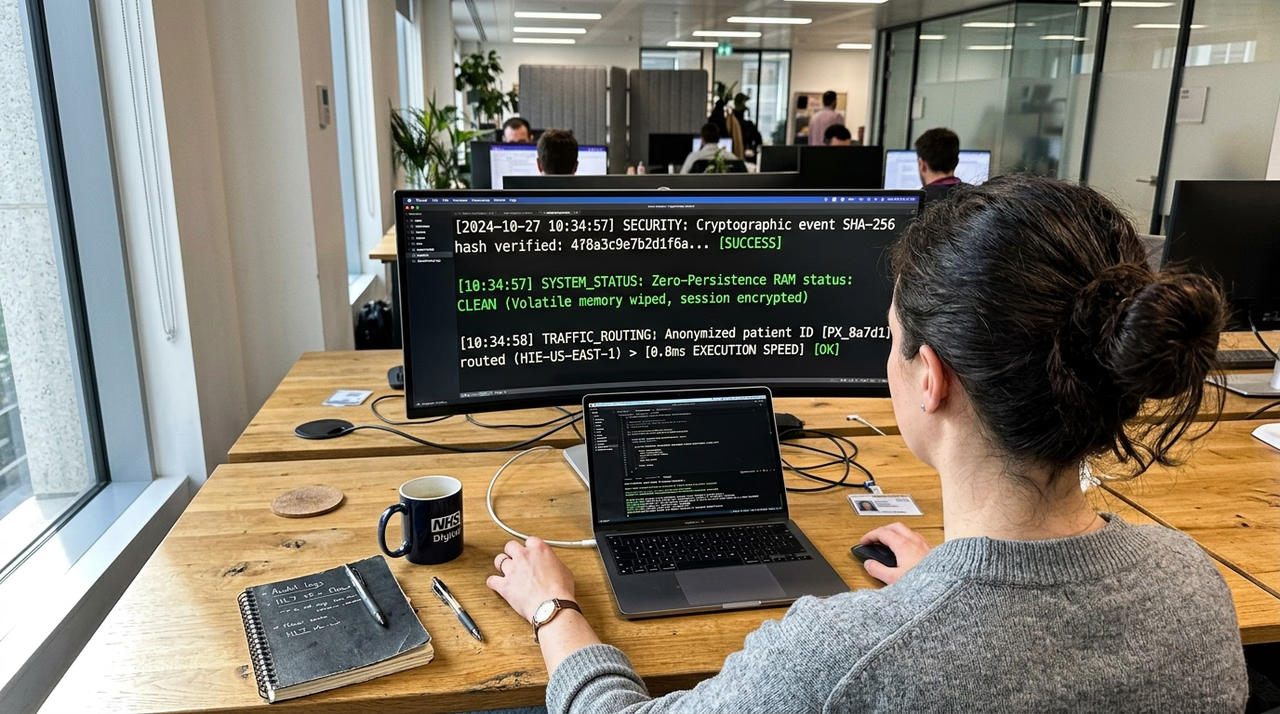
Fraoula Data Auditor operates on the exact same zero-retention philosophy as Apple’s zero-video camera:
- In-Flight Schema & Integrity Auditing: Streaming payloads and database replication events are inspected strictly in ephemeral memory buffers.
- Zero Payload Persistence: The auditor never writes customer PII, credit card tokens, or health diagnosis codes to disk. It detects schema anomalies, reconciliation drift, and malicious mutations entirely in volatile execution space.
- Deterministic Audit Ledgers: Just as Apple’s camera emits signed JSON metadata rather than video frames, Fraoula produces cryptographically verifiable risk reports, checksums, and compliance attestations without storing the underlying business payload.
The First Rule of Epistemic Data Security
Data that does not exist cannot be subpoenaed, leaked, stolen, or corrupted. If an organization requires situational awareness - whether detecting an intruder at the door or detecting silent data drift in an algorithmic payment engine - saving raw continuous payloads is an architectural anti-pattern.
Addressing the Trade-Offs: The Verification Dilemma
Can a security camera succeed in the commercial market if users cannot review footage after an incident? Security analysts have raised the obvious critique: "If a burglary occurs, what do I hand to the police if the camera didn’t record video?"
Apple’s engineering solution hinges on deterministic spatial telemetry and synthetic reconstruction:
- Time-Stamped Multi-Sensor Trajectories: Rather than a grainy 15fps video clip, the camera produces precise vector paths, height and velocity metrics, entry-and-exit timestamps, and clothing coloration histograms.
- Ephemeral Snapshot Exceptions: According to insider leaks, Apple may incorporate a strictly user-authorized, opt-in ephemeral key exchange where a single low-resolution snapshot can be encrypted end-to-end (E2EE) with the user’s private device key - inaccessible to Apple, law enforcement, or any cloud intermediary.
- Integration with the Ambient Sensor Mesh: By acting as a presence anchor rather than an optical recorder, the device triggers home automation (locking Deadbolts, turning on perimeter lighting, dispatching verified Matter alerts) milliseconds before a human eye could review a video stream.
Conclusion: The Sunset of Reckless Video Ingestion
Apple’s decision to build a camera that will not record video is not a quirky hardware experiment; it is the inevitable evolution of edge intelligence. When machine perception models achieve sufficient reliability and run within sub-5-watt thermal envelopes, the justification for persistent optical surveillance evaporates.
In hardware engineering, consumer privacy, and enterprise data governance alike, the future belongs to systems that observe, evaluate, verify, and immediately forget.
Eliminate Data Persistence Risk in Your Enterprise
Audit petabyte-scale streaming pipelines, detect schema corruption, and enforce zero-payload governance across Fintech and Healthtech systems without persisting sensitive records.
Frequently Asked Questions
Why would someone buy a security camera that doesn't record video?
Most smart camera users do not want surveillance archives; they want real-time situational awareness (e.g., knowing when family members arrive, verifying package deliveries, or triggering alarms when an intruder is detected) without the invasive privacy risks, cloud hacking threats, or subpoena liabilities of continuous video storage.
How does on-device computer vision work without saving frames?
The camera's image signal processor (ISP) deposits frames into a temporary volatile memory (SRAM) ring buffer. The Apple Neural Engine performs an instantaneous neural inference pass to identify objects, people, and vectors, after which the memory buffer is immediately wiped and overwritten. No video is ever written to persistent NAND flash or uploaded to the cloud.
How does this relate to Fraoula's enterprise data trust architecture?
Fraoula applies the identical "Zero-Payload Persistence" principle to regulated enterprise data pipelines. Fraoula Data Auditor evaluates schemas, checks algorithmic data integrity, and validates transactions directly in memory streams without persisting sensitive consumer PII, medical records, or financial payloads to disk.